
Germany is entering a new phase in its space strategy, reflecting a broader shift across Europe. Space is no longer just an innovation domain, but a cornerstone of security, resilience, and economic stability.
With up to €35 billion allocated to military space capabilities over the coming years, the German government is taking a decisive step toward building sovereign infrastructure in orbit. The planned investments span satellite communication, early warning systems, cybersecurity, and an independent operational framework for the Bundeswehr.
Space Becomes a Strategic and Contested Domain
This shift comes at a time when space is becoming increasingly contested. The war in Ukraine has demonstrated how critical satellite systems are, not only for military operations, but also for civilian infrastructure such as energy networks, communications, and logistics.
At the same time, cyberattacks targeting space assets have exposed the systemic vulnerabilities of modern economies. Against this backdrop, Germany’s investment is not just a defense initiative, but a geopolitical signal.
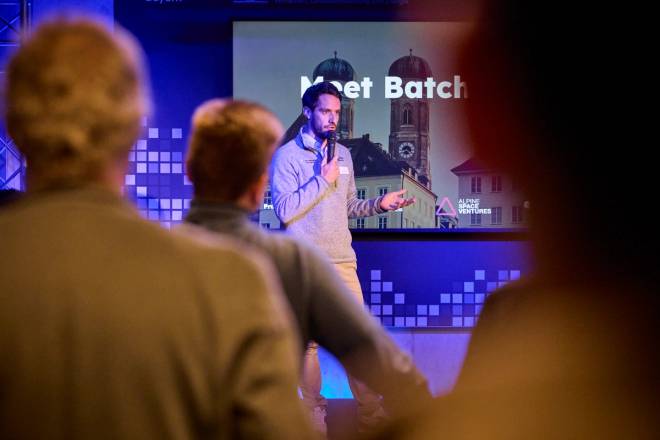
At the Munich Space Summit, this dynamic was clearly visible. Europe is no longer debating whether it needs to build capabilities in orbit, but how quickly and how independently it can do so in an increasingly competitive environment.
Investment Focus: Large-Scale Space Infrastructure
A significant share of the funding is expected to flow into large-scale infrastructure, including a national satellite communication network comparable to systems like Starlink.
Established players such as OHB and Airbus will play a central role in delivering these capabilities, given their experience with complex and mission-critical systems. At the same time, the broader ecosystem tells a more nuanced story.
NewSpace Startups and Their Role in Germany
Germany is home to a rapidly growing NewSpace landscape, with more than 100 startups active across the entire value chain, from upstream technologies to downstream applications.
These companies are often faster, more specialized, and closer to emerging operational needs, yet they remain structurally underrepresented in large public programs.
The reason is not a lack of capability, but a mismatch in system design.
Structural Challenges in Space Procurement
Public procurement in the space and defense domain is still optimized for large and established contractors. Complex procedures, long contracting cycles, and significant upfront requirements create barriers that most startups cannot realistically overcome.
As a result, innovation remains at the margins instead of being integrated into core programs.
If the €35 billion is deployed purely through existing structures, it will strengthen capabilities, but it risks reinforcing the same limitations that have historically slowed down innovation cycles in Europe. If procurement models evolve in parallel, this investment can unlock a more dynamic and resilient ecosystem.
The Integration Gap Between Startups and Demand
At SpaceFounders, this is a pattern we see consistently. Startups are not lacking technology or ambition, they are lacking structured access to demand.
Since 2021, the program has supported over 70 startups across Europe, many of which are building highly relevant solutions for defense, security, and dual-use applications. The bottleneck is not supply, it is integration.
Startups need to be systematically embedded into these programs, not as subcontractors at the margins, but as active contributors to core capabilities.
Rethinking Procurement to Enable Innovation
This requires targeted adjustments, including procurement frameworks that allow for smaller contract sizes, faster iteration cycles, and reduced upfront burdens, as well as dedicated pathways for startups to engage with institutional customers.
Emerging players must be integrated into large-scale system architectures from the outset.
Because ultimately, sovereignty in space will not be achieved by scale alone. It will depend on how effectively Europe can combine industrial strength with continuous innovation.
A €35 Billion Opportunity — if the System Evolves
Germany’s €35 billion commitment creates the opportunity. The real question is whether the system is ready to fully leverage it.
For the full featurette, including additional insights from industry and policy stakeholders, head to DW News.